Tash’s Arrival in Narnia
The Last BattleTash’s arrival in Narnia gives a dreadful bodily answer to a question raised by the occupation: the god invoked by the Calormenes is real, and the creature that appears is the one Tirian remembers from a temple in Tashbaan. Its presence exposes the danger in the Ape’s claim that Tash and Aslan are merely different names for one being, while deepening the Narnians’ confusion about the suffering carried out in Aslan’s name. The arrival is not a rescue or a correction of that suffering; Tash floats north into Narnia, and the old world ultimately ends in grief.
Causes and Religious Deception
The arrival follows a deliberate confusion of names and loyalties. When a Lamb asks how Aslan could be friends with Tash, the Ape spits at him, dismisses the question, and declares that Tash and Aslan are only different names for the same god. The animals recognize the Lamb’s question as the best one asked, but the Ape’s bullying answer replaces inquiry with intimidation. His claim asks them to treat the distinction between their allegiance to Aslan and Calormene worship as meaningless.
The deception is not shared by all its collaborators. Ginger privately asks Rishda Tarkaan what he meant when he said Aslan meant no more than Tash. Rishda explains that he means neither being exists. Ginger understands that the claim lets them deceive those who believe in Aslan while they use the Ape; both conspirators discuss drawing self-interested Narnians into their secret plans. Thus the public assertion that the two gods are one conceals a more cynical private position: the conspirators exploit religious language for political advantage, without believing in either god.
The Creature Appears
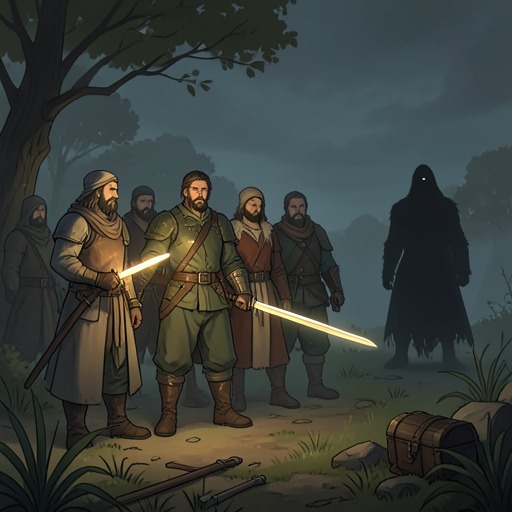
The distinction between claim and reality becomes terrifyingly visible in the clearing. A grey, translucent figure glides slowly northward through the trees. It is roughly man-shaped but has a bird-of-prey’s head and four arms stretched overhead, as if reaching to seize Narnia. All twenty fingers end in long, curved claws. It does not walk; it floats above the grass, which withers beneath it. A deathly smell distinguishes it from smoke, the first mistaken impression its grey, see-through form might give.
The sight halts the witnesses. Puzzle screams and darts into the Tower; Jill covers her face, and the others remain statue-still until the figure disappears into thicker trees. When it has passed, the sun returns and birds begin singing again. The abrupt contrast does not make the encounter harmless: the witnesses first have to recover their breath and move. The interruption of ordinary light and sound makes Tash’s passage an intrusion into the living landscape, not merely a frightening report or a carved image.
Recognition and the Reality of Tash
Tirian recognizes the figure through an earlier encounter. As a boy, while visiting the Tisroc’s court in Tashbaan, he was taken into the great temple of Tash. There he saw a stone image, overlaid with gold, its eyes made of solid diamonds, carved above the altar. The apparition resembles that representation closely enough for Tirian to identify it, transforming a remembered religious image into a present danger.
Eustace asks whether the thing was Tash, but Tirian first turns to Jill and asks how she is. Her face has gone pale; she says she is all right, though the sight briefly made her feel sick. The exchange holds together recognition and bodily shock: naming the creature does not lessen its impact on those who have seen it. The Unicorn concludes that there is a real Tash after all. A Dwarf adds that the Ape, who did not believe in Tash, will get more than he bargained for because he called for Tash and Tash has come. Jewel wonders whether Tash will be visible to the Ape, leaving open whether the creature’s appearance will confront the one who invoked it.
Tash Enters Narnia
Tirian states that the creature has gone north into the heart of Narnia and has come to dwell among them. His words change the encounter from a fleeting sighting into an ongoing threat: Tash is not merely passing through the clearing but has entered the country. The arrival also gives the conspirators’ manipulation an unintended consequence. The Ape’s invocation, made amid a false account of divine identity, cannot ensure that what it calls is only a political fiction.
That revelation does not immediately clarify events for the animals already suffering under the Calormene occupation. Two Mice believe they have seen Aslan ordering the killing of Wood-Nymphs and the enslavement of Narnians. They grieve that the apparent return of the Aslan they longed for has brought violence instead, and wonder whether they have unknowingly done something wrong. A Rabbit likewise suspects that their present conduct may be wrong. Their anguish shows the cost of the deception: when oppressive acts are attributed to Aslan, the victims are led to understand injustice as punishment and to doubt the goodness they trusted.
Aftermath and Significance
The later ending does not erase this confusion by making Narnia’s destruction easy to mourn. Beyond the Stable Door, Lucy insists that it is not wrong to grieve for Narnia and for what lies dead and frozen behind it. Jill had hoped Narnia might last forever, while Digory, who saw it begin, did not expect to live to see it die. Tirian joins their mourning, saying he has seen his mother’s death and known no world but Narnia; not to grieve, he says, would be discourteous. Their sorrow gives the final passage a measure that cannot be reduced to triumph: even in Aslan’s presence, loss remains worthy of lament.
Tash’s arrival is therefore a revelation with no immediate earthly deliverance attached to it. It confirms that the Calormene god is not simply an invented name, while exposing how the Ape’s public theology and the conspirators’ private disbelief distort the Narnians’ understanding of power and suffering. The creature’s northward movement anticipates the danger that has entered Narnia; the survivors’ later grief keeps that danger’s consequences, and the extinguished world they loved, in view.